
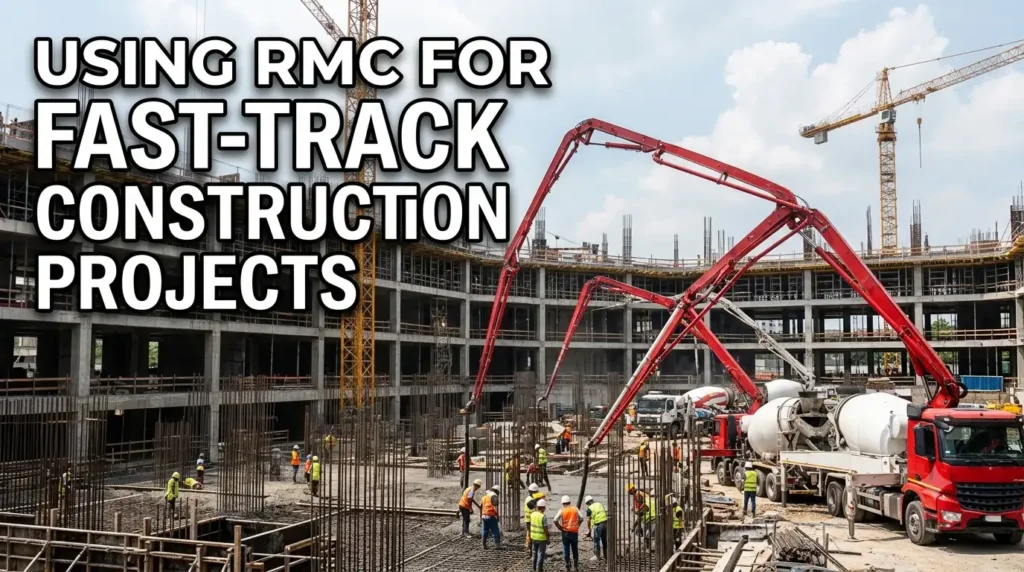
In today’s construction industry, speed and precision often decide the success of a project. Fast-track construction demands materials that are reliable, consistent, and quick to deploy. This is exactly where Ready Mix Concrete (RMC) plays a game-changing role. Unlike traditional site-mixed concrete, RMC is manufactured in a controlled batching plant and delivered ready to use, allowing construction teams to save time without compromising on quality.
What Makes RMC Ideal for Fast-Track Projects
Fast-track construction projects operate on tight schedules where every hour counts. Ready Mix Concrete eliminates several time-consuming steps that traditional concrete mixing requires on site, such as measuring raw materials, mixing, and quality checks.
Key advantages include:
- Consistent quality: Since RMC is produced under controlled conditions, the mix design remains uniform across batches, reducing the risk of structural weaknesses.
- Faster pouring: Ready-to-use concrete arrives at the site prepared for immediate placement, cutting down waiting time significantly.
- Reduced labor dependency: With less manual mixing involved, project teams can allocate workers to other critical tasks.
- Minimal wastage: Precise batching means fewer material losses compared to on-site mixing.
- Better site management: Cleaner sites with less raw material storage improve overall workflow and safety.
How RMC Supports Project Timelines
Time is often the biggest constraint in fast-track projects, whether it’s a commercial building, infrastructure project, or residential complex. Ready Mix Concrete allows contractors to plan pours in advance and receive material exactly when needed, which supports just-in-time construction practices.
This scheduling flexibility becomes especially valuable in the following scenarios:
- Large-scale slab pouring that requires continuous concrete supply without interruption
- Projects located in urban areas with limited space for on-site batching plants
- Multi-story buildings where quick floor-to-floor progression is essential
- Infrastructure work such as roads, bridges, and flyovers with strict deadlines
By removing the guesswork and manual labor involved in traditional mixing, teams can maintain a steady pace throughout the project lifecycle.
Quality Control and Consistency
One of the strongest arguments for using Ready Mix Concrete in fast-track projects is the level of quality assurance it offers. Batching plants use computerized systems to measure cement, aggregates, water, and admixtures with high accuracy. This level of precision is difficult to replicate through manual on-site mixing.
Some quality benefits worth noting:
- Standardized mix ratios that meet project specifications every time
- Reduced human error compared to manual batching
- Better compressive strength and durability outcomes
- Compliance with industry standards and codes
For projects where structural integrity cannot be compromised due to speed, this consistency becomes a critical factor in decision-making.
Cost and Resource Efficiency
While the upfront cost of RMC might appear slightly higher than site-mixed concrete, the long-term efficiency often results in overall savings. Reduced labor requirements, less material wastage, and faster project completion all contribute to lower total costs.
Additionally, fast-track projects benefit from:
- Lower equipment rental duration since mixing equipment isn’t required on-site
- Reduced storage space needed for raw materials like sand, cement, and aggregates
- Fewer delays caused by mixing errors or inconsistent batches
These savings, combined with faster turnaround, make Ready Mix Concrete a practical choice for contractors working under strict deadlines.
Environmental and Safety Considerations
Fast-track construction doesn’t mean cutting corners on safety or sustainability. RMC production generates less dust and noise pollution compared to on-site mixing. It also reduces the number of vehicles and equipment needed at the site, contributing to a safer working environment.
From a sustainability standpoint, controlled batching also means better resource optimization, since materials are measured precisely rather than estimated manually.
Conclusion
For construction projects that demand speed without sacrificing structural quality, Ready Mix Concrete offers a dependable solution. From faster pours and reduced labor needs to consistent quality control, RMC addresses many of the challenges that come with fast-track timelines. As urban construction continues to grow and deadlines become tighter, adopting RMC is becoming less of an option and more of a necessity for contractors aiming to deliver projects efficiently and reliably.