
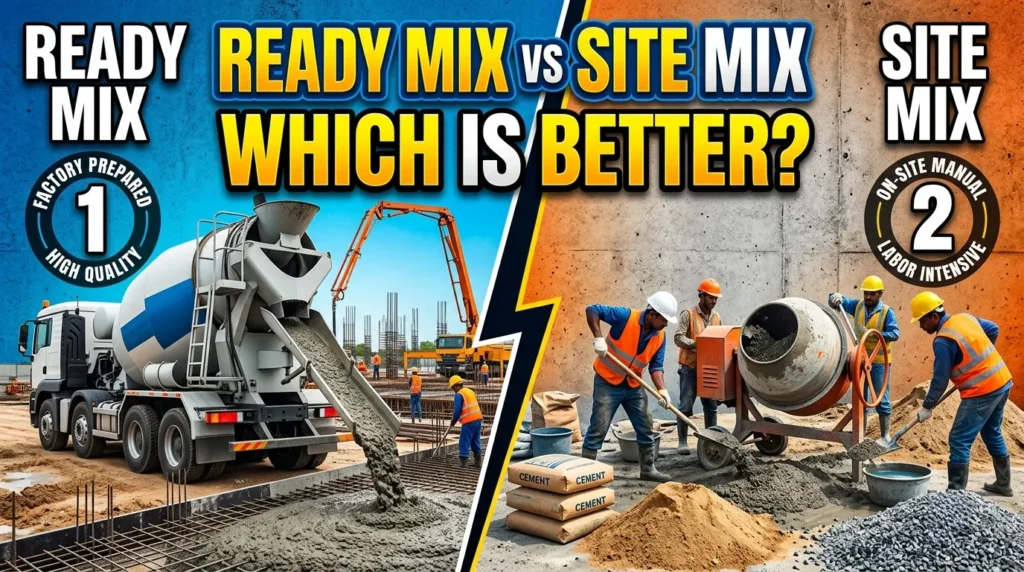
Choosing the right concrete affects the strength, cost, and lifespan of any structure. The debate over ready mix concrete vs site mix concrete comes up on almost every building project. This guide gives a clear answer so you can decide with confidence.
What Is Ready Mix Concrete?
Ready mix concrete (RMC) is produced in a batching plant under controlled conditions. Cement, aggregates, water, and admixtures are measured by weight and mixed to a specific grade such as M20 or M25. Transit mixers then deliver it to your site, ready to pour.
What Is Site Mix Concrete?
Site mix concrete is prepared on the construction site, usually with a small mixer or by hand. Workers measure materials by volume, often using buckets or pans, and mix them just before use.
Key Differences at a Glance
Quality and consistency
- Ready mix concrete uses automated batching, so every load matches the design mix.
- Site mix concrete depends on labor skill, so strength can vary from batch to batch.
- Quality control in concrete mixing is far stricter at a plant, with regular slump and cube tests.
Speed and efficiency
- Ready mix concrete is delivered in bulk, so large pours finish faster.
- Site mixing is slow and needs more workers, which can cause cold joints between batches.
Cost
- The cost of ready mix concrete per cubic meter is higher upfront than site mixing.
- Site mix looks cheaper on paper, but wastage, labor, storage, and rework often close the gap.
Site space and cleanliness
- Ready mix needs no storage of sand, cement, or aggregate on site.
- Site mixing needs space for materials and creates more dust and waste.
Concrete strength and durability
- Concrete strength and durability are more reliable with ready mix, thanks to precise water-cement ratios and admixtures.
- Site mix can reach good strength, but only with careful supervision.
Comparison Table
| Factor | Ready Mix Concrete | Site Mix Concrete |
| Quality | High and consistent | Variable |
| Speed | Fast | Slow |
| Labor needed | Low | High |
| Material wastage | Minimal | Higher |
| Best for | Large and structural work | Small and minor work |
When to Choose Ready Mix Concrete
Ready mix is the better option in these cases:
- Slabs, columns, beams, and foundations
- Multi-storey buildings and commercial projects
- Projects with tight deadlines
- Sites with limited storage space
- Work that needs high-grade or special concrete
For most structural work, ready mix is the best concrete for house construction, since a weak batch in a slab or column is costly to fix.
When Site Mix Concrete Makes Sense
Site mix concrete for small projects can still be a practical choice:
- Small repairs and patchwork
- Garden paths and boundary walls
- Low-volume pours of less than 2 to 3 cubic meters
- Remote locations where transit mixers cannot reach
The Verdict
For strength, speed, and reliability, ready mix concrete wins in most situations. It reduces human error, saves time, and delivers the same quality on every pour. Site mix concrete remains useful for small, non-structural jobs where volume is low and access is difficult.
If your project is structural or larger than a small repair, choose ready mix concrete from a trusted supplier, and always ask for test reports and delivery slips.