
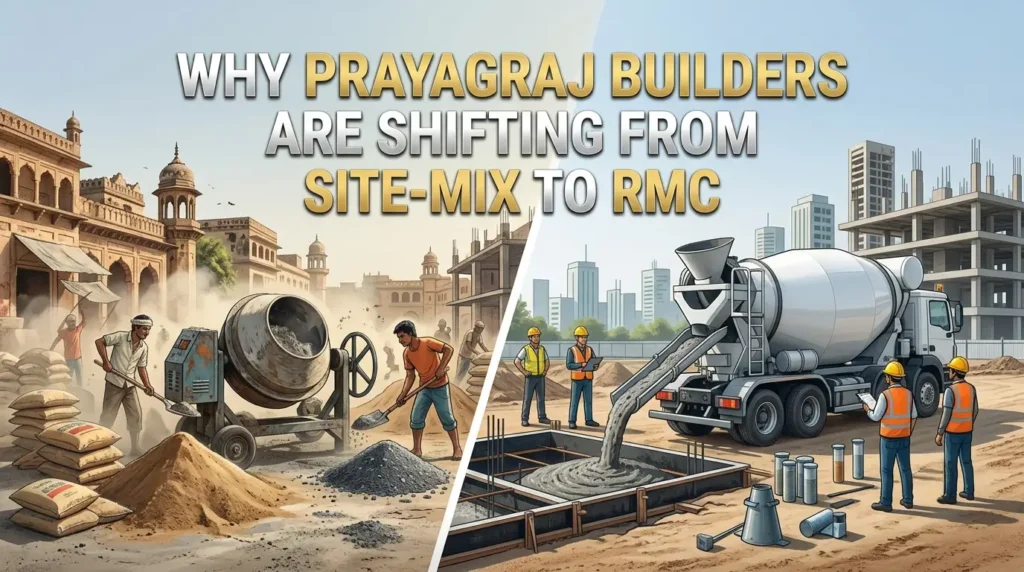
Construction practices in Prayagraj are changing fast. For decades, site mixed concrete was the default choice for most builders. Today, more contractors, developers, and even individual homeowners are switching to RMC (Ready Mix Concrete). This shift is not just a trend, it reflects real gains in quality, speed, and cost efficiency.
Here’s a closer look at why RMC is becoming the preferred choice across Prayagraj’s construction sites.
1. Consistent Quality on Every Pour
Site mixing depends heavily on manual labor, and quality can vary from one batch to another. RMC is produced in a controlled plant environment using calibrated equipment, which means:
- Every batch follows the same water cement ratio
- Material proportions are measured precisely, not estimated
- Strength testing is done before dispatch, reducing structural risk
This consistency matters most in multi storey buildings, where uneven concrete strength can compromise safety.
2. Faster Construction Timelines
Time is money on any project, and RMC helps builders save both. Since the concrete arrives ready to pour:
- There’s no need to source, store, or mix raw materials on site
- Large volumes can be poured in a single continuous operation
- Labor previously used for mixing can be redirected to other tasks
Builders in Prayagraj working on commercial and residential projects with tight deadlines are finding this speed advantage hard to ignore.
3. Reduced Space and Storage Issues
Urban plots in Prayagraj, especially in areas like Civil Lines, Katra, and Allahpur, often don’t have room for storing sand, aggregate, and cement in bulk. RMC solves this problem by:
- Eliminating the need for on site raw material storage
- Reducing clutter and improving site safety
- Making it easier to work on compact or narrow plots
This is a major reason smaller builders are also adopting RMC, not just large developers.
4. Lower Wastage and Better Cost Control
Site mixing often results in over ordering of materials to avoid running short mid pour. This leads to wastage that adds up over a project’s lifetime. With RMC:
- Builders order the exact quantity needed for each pour
- Excess material costs are minimized
- Labor costs related to manual mixing go down significantly
Over the course of a full project, these savings can be substantial, even though the per cubic meter cost of RMC may appear higher upfront.
5. Environmental and Site Cleanliness Benefits
Dust, noise, and material spillage from on site mixing affect not just the construction crew but also neighboring properties. RMC reduces these issues because mixing happens off site at the plant. This is becoming increasingly important as residential areas in Prayagraj grow denser and construction near occupied buildings requires more care.
6. Better Suited for Modern Structural Demands
As building designs in Prayagraj move toward taller structures, basements, and specialized elements like raft foundations, the tolerance for error in concrete quality shrinks. RMC offers the strength, consistency and technical specifications these designs require, something that’s difficult to guarantee with manual site mixing.
Conclusion
The shift from site mix to RMC in Prayagraj is being driven by practical concerns: quality assurance, faster project completion, better use of limited urban space, and long term cost efficiency. As the city’s construction sector matures and project sizes grow, RMC is increasingly seen not as a premium option but as a standard requirement for reliable, professional grade construction.
For builders weighing the switch, the evidence on the ground in Prayagraj makes a strong case: RMC delivers the consistency and convenience that today’s construction demands.