
Choosing the right concrete grade is one of the most important decisions in any construction project. If you are planning a house, a boundary wall or a commercial building, you have probably come across the terms M20 and M25. Understanding the difference between M20 and M25 concrete helps you avoid overspending and also keeps your structure safe and durable.
What Does the “M” Mean in Concrete Grades?
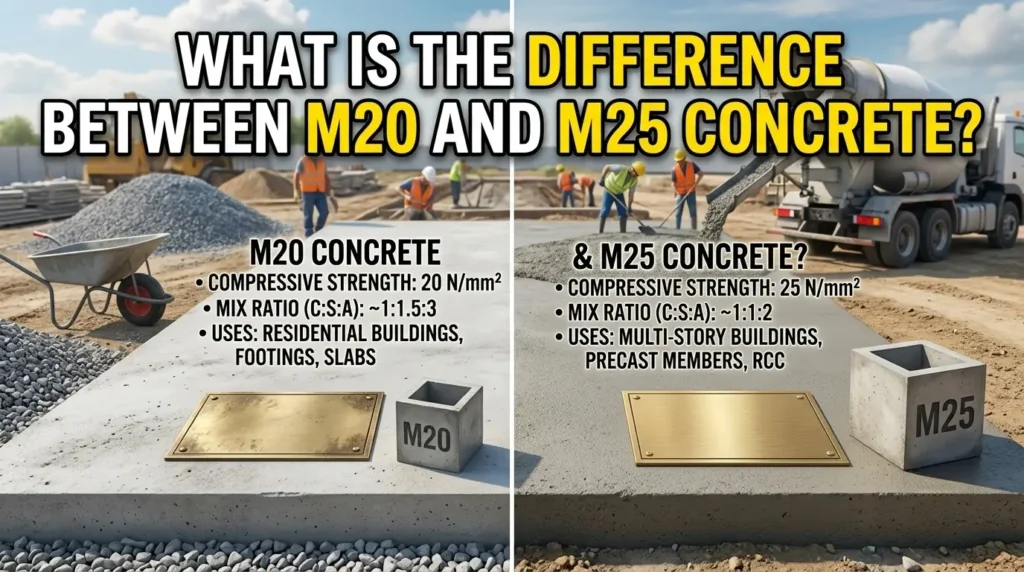
The letter “M” stands for “Mix,” and the number shows the characteristic compressive strength of concrete after 28 days of curing, measured in N/mm² (megapascals). So M20 concrete has a strength of 20 N/mm², while M25 reaches 25 N/mm². A higher number means the concrete can bear more load before failing.
Strength Comparison
The most obvious difference between M20 and M25 concrete is compressive strength. M25 is about 25 percent stronger than M20. That extra strength makes M25 better suited to structures that carry heavier loads or face harsher conditions.
M20 is strong enough for ordinary residential construction, where loads are moderate and spans are short. M25 gives you a higher safety margin and is often preferred for multi-storey buildings and larger spans.
Mix Ratio
Concrete is a mix of cement, sand (fine aggregate) and coarse aggregate. The nominal mix ratios are:
- M20: 1 : 1.5 : 3 (cement : sand : aggregate)
- M25: 1 : 1 : 2 (cement : sand : aggregate)
M25 uses a larger share of cement, which is why it is stronger and also more expensive. In practice, modern projects often use design mixes prepared in batching plants rather than nominal ratios, because design mixes control quality more accurately.
Cement Content and Cost
Because M25 needs more cement per cubic metre, it costs more than M20. As a rough guide, M20 needs around 320 to 350 kg of cement per cubic metre, while M25 needs around 380 to 400 kg. The exact figures depend on the aggregate size, water-cement ratio and any admixtures used.
For a small house, the cost gap may look minor. For a large project with thousands of cubic metres of concrete, it adds up quickly. Many builders use M20 for general work and reserve M25 for structural elements that need extra strength.
Durability and Exposure Conditions
Durability is another important part of the difference between M20 and M25 concrete. According to IS 456, the Indian standard for plain and reinforced concrete, the minimum grade depends on the exposure condition:
- Mild exposure: M20 is the minimum for reinforced concrete.
- Moderate exposure: M25 is the minimum.
- Severe and above: M30 or higher is recommended.
If your site is near the coast, in a humid area or exposed to chemicals or heavy rain, M25 offers better resistance against corrosion and water penetration. Its denser mix also lowers permeability, which protects the steel reinforcement inside.
Common Applications
M20 concrete is commonly used for:
- Residential slabs, beams and columns in low-rise buildings
- Footings and foundations for light structures
- Boundary walls, sunshades and lintels
- Pavements and floors under normal loads
M25 concrete is commonly used for:
- Multi-storey residential and commercial buildings
- Beams, columns and slabs with heavier loads
- Bridges, culverts and retaining walls
- Structures in moderate exposure zones
Workability and Placement
Both grades can be made workable with the right water content and admixtures. Since M25 contains more cement, it can feel stickier and may need careful curing to avoid shrinkage cracks. Proper compaction and at least seven days of curing are essential for both grades to reach their design strength.
Quick Comparison Table
| Feature | M20 | M25 |
| Strength at 28 days | 20 N/mm² | 25 N/mm² |
| Nominal mix | 1 : 1.5 : 3 | 1 : 1 : 2 |
| Cost | Lower | Higher |
| Exposure | Mild | Moderate |
| Typical use | Low-rise homes | Larger buildings |
Which One Should You Choose?
If you are building a standard single or two-storey house in a mild climate, M20 is usually enough and keeps costs down. If your project involves heavier loads, taller structures or tougher environmental conditions, M25 is the safer investment. Always consult a structural engineer, because the final decision should follow your design calculations and local building codes.
Conclusion
The difference between M20 and M25 concrete comes down to strength, cement content, cost and suitability for different conditions. M20 is economical and ideal for light to moderate construction, while M25 gives extra strength and durability where the structure demands it. Choosing correctly ensures a safe, long-lasting building without unnecessary expense.